
62% of Older Adults Unaware of Potential Connection Between Oral Health and Brain Health, Delta Dental Survey Finds
PR Newswire
SAN FRANCISCO, Nov. 10, 2026
New Delta Dental Insurance Company research reveals gaps in older adults’ awareness of the possible link between oral and cognitive health, caregivers’ need for guidance and dental providers’ firsthand experience with changing patient needs
SAN FRANCISCO, Nov. 10, 2026 /PRNewswire/ — Cognitive decline can make daily oral care harder to provide and prioritize. A new survey from Delta Dental Insurance Company (Delta Dental) finds that caregivers are often navigating this responsibility and look for more guidance and support, and that many older adults are unaware of the possible connection between oral health and brain health. Delta Dental’s 2026 Cognitive Decline and Oral Health Survey also shows that dental providers are seeing the effects firsthand, with 82% treating a patient experiencing cognitive decline in the last month.
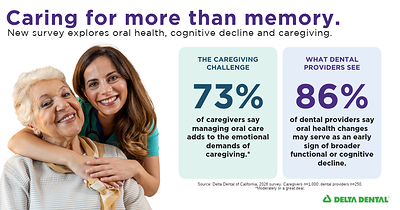
The survey examines oral health and cognitive health from three perspectives: older adults, caregivers and dental providers. The findings reveal gaps in awareness of the possible connection, challenges in maintaining oral care as cognitive decline progresses and a need for more guidance for families and providers.
“Oral health belongs in the conversation about healthy aging, including cognitive health,” said Sarah Chavarria, CEO of Delta Dental Insurance Company. “Our findings show that older adults want more information, families need guidance and dental providers are seeing changes in their patients firsthand. We’re using these insights to help people better understand their oral health and get the support they need as they age.”
Caregivers recognize a possible connection but need support
Most caregivers see a possible link between oral health and brain health. But many are unsure how to act on it. Sixty-one percent believe oral health could be connected to cognitive decline, and 63% are unsure they are providing oral care correctly. More than 7 in 10 (76%) caregivers want clearer guidance, and 79% want advice or resources from dental providers on caring for an older adult’s oral health.
Sixty-three percent of caregivers say they sometimes or often skip or delay brushing or flossing due to competing demands, highlighting the need for additional support and resources when it comes to oral care and supporting an older adult with cognitive decline.
The stakes go beyond hygiene. Ninety percent say maintaining their loved one’s oral health helps preserve dignity and quality of life.
Dental providers see the effects of cognitive decline on oral health
Dental providers are seeing the oral health challenges associated with cognitive decline firsthand. Eighty-six percent say oral health changes can be an early sign of broader cognitive decline, and 78% feel more confident addressing oral health issues related to physical aging than those associated with cognitive decline. Although 72% of providers screen for cognitive changes in patient health histories, these findings point to an opportunity for additional education and support.
“Dental visits can offer an important opportunity to recognize changes in oral health and help families understand how care needs may evolve alongside cognitive decline,” said Dr. Daniel W. Croley, Chief Dental Officer at Delta Dental Insurance Company. “By making oral health part of the broader conversation about healthy aging, we can help patients and caregivers feel better equipped to navigate these changes.”
Older adults value oral health, but the brain connection is a blind spot
Although 81% of older adults say oral health plays a meaningful role in their quality of life, fewer are familiar with its possible relationship to cognitive health. Only 38% of adults 65 and over have heard that bacteria from the mouth could travel to the brain and contribute to inflammation linked to cognitive decline, compared with 76% of caregivers. Just 30% believe poor oral health may increase Alzheimer’s risk, highlighting a broader gap in understanding the connection.
Awareness may be a catalyst for action:
- 83% of older adults want more research into the possible relationship between oral bacteria and cognitive impairment, including Alzheimer’s disease and other forms of dementia.
- 82% say they would prioritize their oral health care after learning about the possible connection.
These findings underscore an opportunity to make oral health a more consistent part of healthy aging conversations and to give caregivers the practical guidance they need as care needs change. Delta Dental encourages older adults and caregivers to talk with their dental providers about challenges with daily oral care and ways to maintain routines that support comfort, dignity and quality of life. For more insights, view Delta Dental’s full report.
Delta Dental is committed to providing older adults with consistent, quality access to oral health care and resources to improve overall health and well-being. Improving education and driving lasting policy changes to address systemic issues is a key priority within the Delta Dental organization. To learn more, visit www.deltadentalins.com.
About Delta Dental of California and Affiliates
Since 1955, Delta Dental of California and Affiliates has offered comprehensive, high-quality oral health care coverage to millions of enrollees and built the strongest network of dental providers in the country. The Delta Dental of California enterprise includes its affiliates Delta Dental Insurance Company, Delta Dental of Pennsylvania, Delta Dental of New York, Inc., as well as the national DeltaCare USA network, and provides dental benefits to more than 27 million people across 15 states and the District of Columbia.* All are members of the Delta Dental Plans Association based in Chicago, Illinois, the not-for-profit national association that through a national network of Delta Dental companies collectively covers millions of people nationwide. Delta Dental is a registered trademark of Delta Dental Plans Association. For more information about Delta Dental of California and its affiliates, please visit www.deltadentalins.com.
*Delta Dental of California’s operating areas encompass Alabama, California, Delaware, Florida, Georgia, Louisiana, Maryland, Mississippi, Montana, Nevada, New York, Pennsylvania, Texas, Utah, West Virginia, and the District of Columbia.
Methodology
Delta Dental commissioned Atomik Research to conduct three online surveys throughout the United States: 1,000 adults aged 40 and over who care for an aging family member, 1,000 adults aged 65 and over, and 250 dental providers. The margin of error is plus or minus 3 percentage points for each consumer survey and plus or minus 6 percentage points for the provider survey, each at a 95 percent confidence level. Fieldwork was conducted between July 1 and July 7, 2026. Atomik Research, part of 4media group, is a creative market research agency.
The survey captures respondents’ awareness, experiences and attitudes. It does not establish that poor oral health causes cognitive decline or that oral care prevents Alzheimer’s disease.
For media inquiries, contact:
Kinga Skowronek
Public Relations Manager at Delta Dental Insurance Company
kskowronek@delta.org
(415) 975-8272

 View original content to download multimedia:https://www.prnewswire.com/news-releases/62-of-older-adults-unaware-of-potential-connection-between-oral-health-and-brain-health-delta-dental-survey-finds-302934114.html
SOURCE Delta Dental of CA


